Jewish Krakow and the Kazimierz Quarter: Heritage, Synagogues and Tours
Jewish Krakow and the Kazimierz Quarter is easy to flatten into a single afternoon of pretty synagogues and trendy cafés, and locals notice when visitors leave having done exactly that. Kazimierz was Krakow’s independent Jewish town for over five hundred years before it became a district of the city, home to one of Europe’s most significant Jewish communities until the occupation devastated it. What remains — synagogues, a cemetery, a square, a handful of streets — carries that full weight, even on the days it also happens to be a good place for coffee.
This guide covers what Kazimierz actually is, the synagogues worth your time, whether a walking tour is worth booking over going alone, and how to see the quarter without reducing it to a backdrop.
What Kazimierz Actually Is
Kazimierz was founded as its own royal town in 1335, separate from Krakow, and became the centre of Jewish life in the region from the late 15th century onward after Jewish residents were required to relocate there. By the early 20th century it held one of the largest and most vibrant Jewish communities in Europe — synagogues, schools, markets, and a density of religious and cultural life that shaped the district’s entire character.
The German occupation ended that world. Krakow’s Jewish population was forced into the ghetto across the river in Podgórze from 1941, and the vast majority of Kazimierz’s Jewish residents were murdered in the Holocaust. The quarter emptied and fell into disrepair for decades under Communist rule, only beginning its revival — first as a preservation project, later as a genuinely lived-in neighbourhood again — from the 1990s onward. What visitors see today is a district actively rebuilding a living relationship with a history that very nearly erased it entirely.
By 1939, roughly 60,000 to 70,000 Jewish residents lived in Krakow, the majority connected to Kazimierz in some way — as home, workplace, or community centre. That number gives some sense of scale to what was lost: this was not a small or peripheral community but one of the most significant centres of Jewish religious and cultural life in pre-war Poland, with a density of synagogues, schools, and institutions that took centuries to build and less than a decade to be destroyed.
The Synagogues of Kazimierz
The Old Synagogue on Szeroka Street is the oldest surviving synagogue in Poland, dating to the 15th century and now housing a museum on Jewish history and tradition in the region. The Remuh Synagogue, still active for worship, sits beside the Remuh Cemetery — one of the few Jewish cemeteries in Europe to survive the war largely intact, its weathered gravestones dating back to the 16th century. The Kupa, Tempel, and Izaak synagogues round out the quarter’s religious architecture, each reflecting a different era and community within Kazimierz’s Jewish history.
Most of these can be visited independently, but the context that connects them — why this street rather than another, what a particular gravestone inscription actually means — is where a knowledgeable guide earns their cost.
The Tempel Synagogue, built in the 1860s in a Moorish Revival style quite different from Kazimierz’s older synagogues, reflects the more assimilated Reform Jewish community that built it — its interior is considerably more ornate than the older, plainer Remuh or Old Synagogue, and it occasionally hosts concerts alongside its role as a historical site. The Izaak Synagogue, one of the largest in the district when built in the 17th century, now shows a mix of exhibitions and, on occasion, a short film connecting the space to Kazimierz’s wartime history for visitors who want that context before continuing their walk.
Kazimierz and Schindler’s List
Several scenes of the 1993 film were shot on Kazimierz’s streets, and Szeroka Street in particular appears in a number of them — one reason the square draws visitors who know the district primarily through the movie rather than its actual history. It’s worth knowing before visiting that the film used Kazimierz as a stand-in for the ghetto in Podgórze, which is a different, separate part of the city across the river; conflating the two is a common visitor mistake worth avoiding.
Walking Tour or Going Alone?
Kazimierz rewards a guided walk more than most Krakow neighbourhoods, because so much of what makes it significant isn’t visible from the street — an unmarked building that was once a school, a square that served a specific communal function, the layered history behind why certain synagogues survived and others didn’t. Going alone works well for absorbing atmosphere; a guide is what turns a walk through pretty streets into an understanding of what those streets actually were.
| Format | Typical Length | Best For |
|---|---|---|
| Guided walking tour | 1.5-2 hours | First-time visitors, anyone wanting the history explained in context |
| Self-guided walk | Flexible | Return visitors, those combining it with an unhurried café stop |
| Combined Kazimierz + Ghetto tour | 2.5-3 hours | Visitors wanting the fuller WWII context across both sides of the river |
Given how much of the quarter’s history isn’t visible without context, checking a guided option directly is worth doing before deciding to go it alone — see current availability for the Jewish Quarter and former ghetto walking tour here.
What a Walking Tour Actually Covers
A typical route starts on Szeroka Street among the oldest synagogues, moves through the narrower residential streets that once held Kazimierz’s Jewish schools and shops, and usually ends at Plac Nowy — the square that has become the district’s modern social centre. Tours that extend into the former ghetto add the walk across the river into Podgórze, connecting Kazimierz’s pre-war Jewish life directly to where that community was forced and, for most, ultimately killed.
Kazimierz Beyond the Synagogues
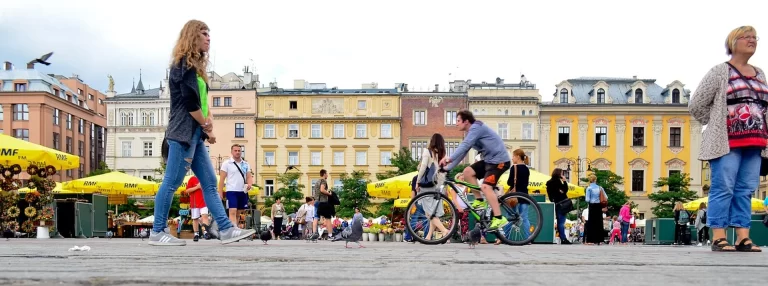
Plac Nowy is the square locals actually use — a round market hall (the “okrąglak”) ringed by zapiekanka stalls, with a Saturday flea market that draws Krakow residents as much as visitors. The district’s café and bar scene, concentrated on and around Józefa and Meiselsa streets, sits comfortably alongside the historic sites rather than in tension with them, which is part of what makes Kazimierz genuinely lived-in rather than preserved behind glass.
Locals tend to visit Kazimierz at two very different hours for two very different reasons: mid-morning for the synagogues and cemetery, when the streets are quiet enough to actually read a plaque, and dusk for Plac Nowy, when the square fills with the kind of ordinary evening life that has nothing to do with tourism at all.
Visiting Respectfully
The Remuh Cemetery and the district’s active synagogues are places of worship and mourning, not photo backdrops — modest dress and quiet behaviour matter here in the same way they would at any religious site. It’s worth remembering, walking through Kazimierz’s more atmospheric streets, that the same setting that photographs well today was, within living memory, the site of a community’s destruction. Holding both truths at once — the district’s current vitality and its history — is part of visiting it well.
For a shorter, synagogue-focused route without the ghetto extension, check availability for the Kazimierz Jewish Quarter walking tour here.
This is not a request to visit solemnly throughout — Plac Nowy in the evening is meant to be enjoyed, and locals themselves treat it that way. The distinction that matters is between the district’s living present, which is genuinely fine to enjoy as such, and its historic and religious sites specifically, which ask for a different kind of attention.
Best Time of Day to Visit
Mornings, particularly before 10am, offer the quietest version of the synagogue district — the Old Synagogue and Remuh Cemetery are far easier to actually absorb without competing for space at the more atmospheric corners. Plac Nowy works in the opposite direction: it’s at its best from late afternoon into evening, when the square fills with the ordinary rhythm of local life rather than daytime tour traffic. A visit that spans both — synagogues in the morning, the square at dusk — captures Kazimierz’s two very different registers in a single day.
Where to Eat in Kazimierz
Zapiekanka — an open-faced baguette piled with mushrooms, cheese, and toppings, toasted until crisp — is the food most associated with Plac Nowy, sold from the walk-up windows ringing the old market hall late into the night. Beyond the square, Kazimierz holds a strong concentration of Jewish-style restaurants serving pierogi, cholent, and other dishes connected to the district’s pre-war community, alongside a newer wave of cafés and bars that have made streets like Józefa genuinely good for an unhurried evening.
Getting to Kazimierz
Kazimierz sits immediately south of the Old Town, an easy fifteen-to-twenty-minute walk from the Main Square along Starowiślna or Krakowska streets. Trams 3, 9, 11, 13, and 24 all serve the district if walking isn’t practical, with stops close to Szeroka Street and Plac Nowy. Unlike the day trips covered elsewhere in this guide, no advance transport planning is needed — Kazimierz is very much part of central Krakow, not a separate excursion.
Combining Kazimierz with Other Sites
The most natural pairing is the former ghetto in Podgórze, just across the Vistula, which many guided tours already include as an extension. Schindler’s Factory sits within that same walkable area, making a combined Kazimierz–ghetto–factory route a genuinely coherent half-day for visitors focused on this period of the city’s history. Pairing Kazimierz with the Old Town on the same day also works well, since the two are close enough to walk between without losing significant time.
The Remuh Cemetery Up Close
Behind the Remuh Synagogue, the cemetery holds graves dating from the 16th century, many of their inscriptions still legible after nearly five hundred years — a rarity among Jewish cemeteries in this part of Europe, most of which were destroyed or badly damaged during the occupation. A section of wall along one edge, assembled from fragments of gravestones smashed during the war and later recovered, has become known as the “Wailing Wall” of Kazimierz, a deliberate act of reconstruction from destruction that visitors often find more affecting than any single intact grave.
Photography and Etiquette
Photography is generally permitted in the synagogues functioning as museums, though flash is typically discouraged and, in the Remuh Synagogue specifically, photography is restricted during active worship. The cemetery permits respectful photography but not the kind of posed portrait shots increasingly common at historic sites elsewhere in Europe — a distinction worth being aware of before arriving with a long list of photo spots planned.
Kazimierz for Return Visitors
Travellers back in Krakow for a second time often get more out of Kazimierz than they did on their first visit, once the pressure to see every synagogue on a checklist has faded. A slower second pass — a single synagogue revisited properly rather than four seen quickly, an afternoon at a café with no fixed itinerary, a longer look at the Remuh Cemetery’s inscriptions — tends to leave a stronger impression than the more comprehensive first-time walk. If Kazimierz was rushed the first time around, it is one of the more rewarding places in Krakow to deliberately slow down for on a return trip.
A Quarter, Not a Museum
The clearest sign that Kazimierz has succeeded in rebuilding itself is how ordinary parts of it now feel — a bakery queue, a Saturday market stall, a group of students at a café table, none of it staged for visitors. That ordinariness sits directly beside sites carrying some of the heaviest history in the city, and the district doesn’t resolve that tension so much as hold it, day to day, without much comment. Visitors who notice that — rather than treating Kazimierz purely as a historic backdrop or purely as a nightlife district — tend to come away with a fuller sense of what the quarter actually is.
What to Read Next
Deeper guides on specific parts of this pillar are being published as it develops — links will be added here as each goes live.
- Jewish Krakow Walking Tour: What You See, Learn and Where It Goes
- Best Kazimierz Walking Tours Compared: Heritage Over Sightseeing
- Schindler’s List Filming Locations Tour: The Sites and the Real Story
- Private Jewish Heritage Guide in Krakow: When It’s Worth the Cost
- Things to Do in Kazimierz: A Half-Day Route Through the Quarter
- The Synagogues of Kazimierz: Which Ones to Visit and What Each Holds
- Plac Nowy and Its Zapiekanka Stalls: Where Memory and Market Meet
- Kazimierz at Dusk: The Hour Most Visitors Walk Through Too Fast
- Old Synagogue and Remuh Cemetery: The Heart of Jewish Krakow
- The History of Jewish Krakow: What Kazimierz Was Before 1939
- Where to Eat in Kazimierz: Jewish-Style Restaurants and Marta’s Picks
- How to Visit Jewish Krakow Respectfully: A Thoughtful Visitor’s Guide
Frequently Asked Questions
Is Kazimierz the same as the Krakow Ghetto?
No. Kazimierz was Krakow’s historic Jewish quarter for centuries. The ghetto, established by German occupying forces in 1941, was a separate area across the river in Podgórze, where Krakow’s Jewish population was forcibly relocated.
How long do I need to see Kazimierz?
A guided walking tour typically runs 1.5 to 2 hours. Half a day allows time for the synagogues, Plac Nowy, and an unhurried coffee stop without rushing.
Are the synagogues in Kazimierz still active?
The Remuh Synagogue remains an active place of worship. Others, including the Old Synagogue, now function primarily as museums covering Jewish history and tradition in the region.
Is a guided tour worth it for Kazimierz?
Much of what makes Kazimierz significant isn’t visible from the street alone. A guide adds meaningful context for first-time visitors; a self-guided walk works well for those revisiting or short on time.
What is Plac Nowy known for?
A round market hall known locally as the “okrąglak,” ringed by zapiekanka stalls, plus a Saturday flea market. It functions as Kazimierz’s modern social centre as much as a historic site.
Can Kazimierz be combined with a Schindler’s Factory visit?
Yes — some guided tours combine Kazimierz with the former ghetto in Podgórze, which sits near Schindler’s Factory, making it possible to cover both in one extended outing.
The Kazimierz that exists today is not a recreation and not a museum piece — it is a neighbourhood that was nearly erased and rebuilt itself into something genuinely alive again. Visiting it well means noticing both halves of that story, not just the half that makes for a good photograph.
Plan your visit: Official site · Google Maps